
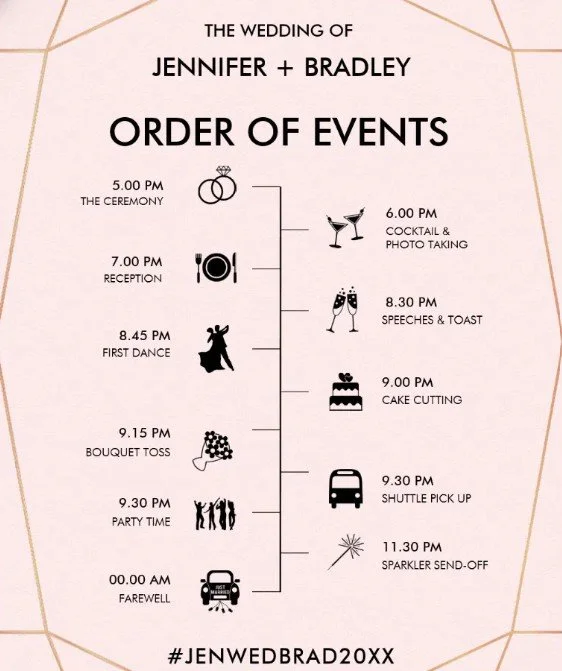
A wedding day timeline is not just a schedule, it’s the operating system for your entire event. When it’s built well, vendors move in sync, guests feel cared for, and the couple stays present instead of managing logistics in real time.
When it’s missing or rushed, even the most beautiful venue can feel disorganized.
At Julia Morgan Redwood Grove, we require a final vendor timeline meeting 30 days prior to every event because weddings don’t succeed by chance, they succeed through coordination.
Why the timeline matters so much
A wedding day is a layered production happening all at once:
Multiple vendors arriving on different schedules
Setup and load-in windows that must be coordinated carefully
Hair, makeup, photography, and transportation running in parallel
Ceremony timing tied to light, guests, and readiness
Dinner service and reception flow dependent on transitions
Without a clear timeline, each vendor operates on their own assumptions, and those rarely align.
A strong timeline brings everything under one shared plan.
Start with your anchors
Before filling in details, identify the non-negotiable anchor points of the day:
Ceremony start time
Sunset (critical for photography)
Dinner service time
Vendor load-in windows
Reception end time / music cutoff
Everything else is built around these fixed moments.
At Julia Morgan Redwood Grove, sunset is especially important due to the natural lighting in the gardens and open lawn spaces, it often drives the entire photographic and ceremony structure.
Work backwards, not forwards
One of the most common mistakes is starting at the ceremony and building forward.
A stronger method is to reverse engineer the entire day:
Reception end time
Dinner service
Cocktail hour
Ceremony
Getting-ready time
Vendor setup and load-in
This approach prevents a common issue: a perfectly planned ceremony that leaves no buffer for setup, photography, or transitions.
Build buffer time into every phase
A timeline that looks “tight” on paper will almost always break in real time.
Effective timelines intentionally include padding:
15–30 minutes between major transitions
Extra time for vendor arrival and parking
Flexible photography windows
Early guest seating before ceremony start
Buffer time isn’t excess, it’s protection against cascading delays.
The three layers of a wedding timeline
A complete timeline should exist in three versions:
1. Master timeline (planner + venue + all vendors)
The full operational document with logistics, contacts, and movement details.
2. Vendor-specific timeline
Simplified versions tailored to each vendor’s role, arrival time, setup window, and responsibilities.
3. Couple timeline (experience-based)
A clean, emotional flow of the day without logistical noise.
Each version serves a different purpose, but they must stay aligned.
Common timeline mistakes
Most timeline issues come from predictable oversights:
Underestimating vendor setup time
Forgetting load-in restrictions or access routes
Scheduling ceremony too close to sunset
Not planning guest movement between spaces
Missing a designated point person for real-time adjustments
Individually small problems, but together they create delays that compound quickly.
How we handle timelines at Julia Morgan Redwood Grove
Because the estate includes multiple distinct environments, gardens, lawns, historic buildings, and lodging, timing is directly tied to movement across the property.
Our 30-day final vendor meeting ensures:
Confirmed arrival and load-in schedules
Clear staging and access coordination
Alignment of ceremony and reception flow
Identification of conflicts before event day
A single, unified timeline shared across all vendors
The goal is simple: everyone arrives already aligned.
Final thought
A wedding timeline isn’t about control, it’s about clarity. When everyone understands where they need to be and when, the day runs more smoothly for vendors, more calmly for the couple, and more naturally for guests.
A good timeline fades into the background. A bad one becomes the event itself.