
Bringing The Gazelles Home
The Story of a Lost Fabric Recreated for Julia Morgan Redwood Grove
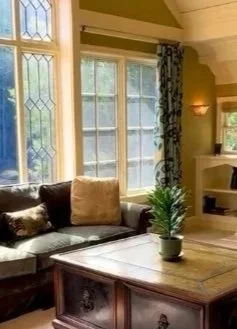
Some of the most meaningful pieces of a historic home are not the things that immediately catch your eye.
They may be hidden in the folds of a curtain, woven into a pattern on a chair, or tucked away on an old bed. They are the details that quietly connect a house to the people who lived there nearly a century ago. At Julia Morgan Redwood Grove, one of those details was a beautiful fabric dating back to the home's earliest years.
And for years, it was missing.
A Pattern Worth Finding
When Tanya Musgrave, property owner, began looking closely at the historic interiors of Julia Morgan Redwood Grove, she became fascinated by the original textiles that had once been part of the home. Among them was a distinctive fabric depicting gazelles among the trees, a pattern that belonged to the character of the house and to the period in which Julia Morgan designed it. But finding the fabric again was not as simple as ordering a replacement. The original material was no longer readily available. The trail had to be pieced together through research, old records, conversations, photographs, and countless inquiries to people who might know where the fabric had originated or who might be able to reproduce it. What began as a search became a project that stretched over several years. Tanya kept looking. She contacted people, followed leads, researched textile companies and historic fabrics, and continued searching for someone who could help bring this small but important piece of the home's history back to life.
Finding the Gazelles
Eventually, the search led to the fabric known as “Les Gazelles Au Bois”, French for “The Gazelles in the Woods”. The reproduction fabric was produced by Schumacher, in the NOIR colorway. The specifications for the project call for a 55-inch-wide fabric with a substantial repeat, and the order ultimately required 16.5 yards of material. But the significance of the fabric is much greater than its measurements. It was a way to restore something that photographs and memories could tell us had once belonged here. Rather than introducing a new pattern simply because it was beautiful, the goal was to return a piece of the home's visual history to its rightful place.
More Than Curtains
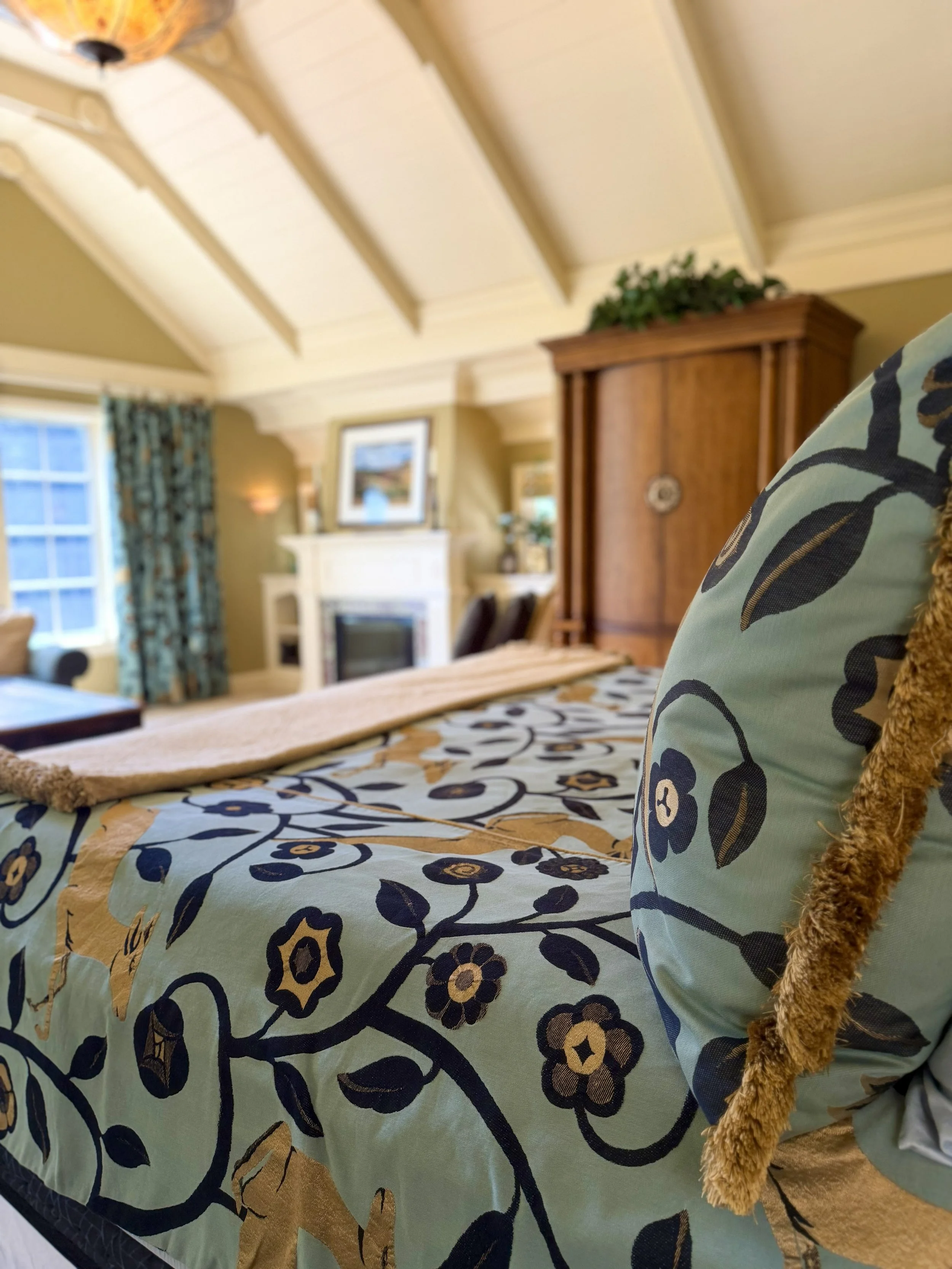
Photography: Early Edge Media
Today, the fabric can be experienced throughout the estate. It became drapery, pillows, a bedspread, and upholstered chairs, allowing the pattern to move naturally through the rooms rather than existing as a single isolated reproduction. The gazelles once again appear among the trees. The fabric brings color, pattern, and texture into the interiors, but perhaps more importantly, it creates a subtle connection between the home as it was nearly a century ago and the home visitors experience today.
There is something special about sitting in a room surrounded by a pattern that was chosen with the character of this house in mind. It makes the passage of time feel a little less distant.
Preservation Is in the Details
Historic preservation is often imagined as something grand: restoring a roof, repairing a stone wall, protecting original woodwork, or maintaining an important architectural feature. But preservation also happens in the details.
It happens when someone takes the time to ask what once hung in a window. It happens when an old photograph reveals a pattern that has disappeared. It happens when someone spends years searching for an answer rather than accepting that something is simply gone. And sometimes, preservation means finding the right people to recreate something that can no longer be purchased. For Julia Morgan Redwood Grove, the story of the Gazelles is one of those details. It is a story of patience, research, persistence, and a deep respect for the history of the house.
Today, the fabric is no longer simply something from the past.
It is here again, woven into the rooms of Julia Morgan Redwood Grove, surrounding guests with a pattern that feels as though it has always belonged.
A little piece of 1926 has found its way home.