
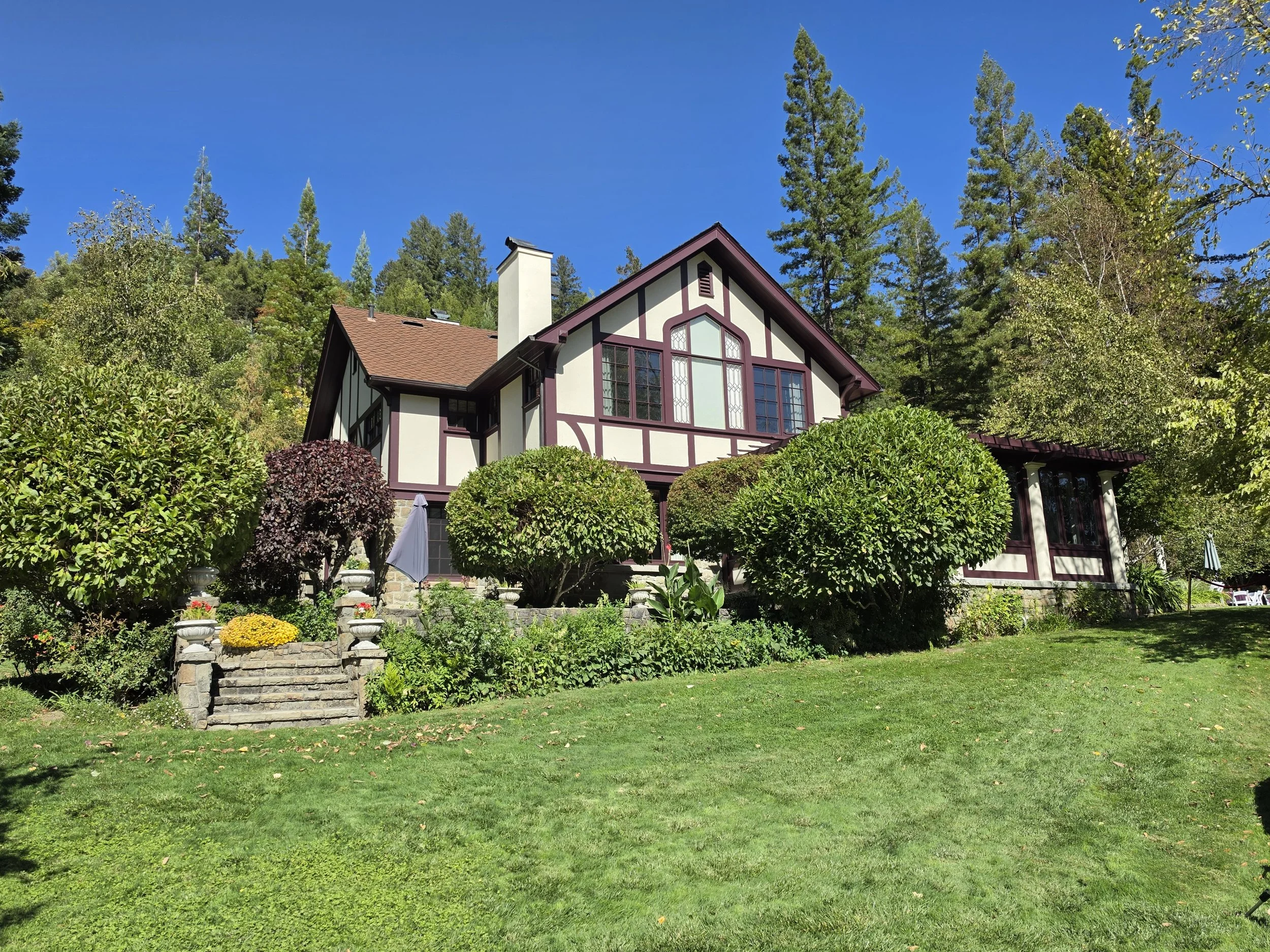
Some places are difficult to explain. You can describe their architecture, their history, their surroundings, and all the things that make them beautiful, but somehow the words never quite capture how they make you feel.
Julia Morgan Redwood Grove is one of those places.
There is something about the arrival. As you make your way down the driveway past the angel standing steady, the trees and foliage begin to surround you. The outside world seems to grow quieter, and the landscape slowly reveals the house, standing among the trees and overlooking the Eel River. It feels almost like discovering a hidden place, a little world tucked away from everything else.
And then you walk inside.
There is beauty in the details, some immediately apparent and others you discover only after spending time in the house. The wallpaper, with its birds and intricate patterns inspired by the surrounding area. The staircase, the decorative rosettes, the beautiful wooden windows with their iron detailing. The rooms, each with its own character, and the unexpected spaces that make you pause and wonder what life must have been like here when the house was new.
I remember being completely enamored with it. Not simply because it was a beautiful historic home, but because it felt as though every corner had something to tell you. You find yourself looking closer, imagining the people who chose these details, who walked these hallways, who looked through these very windows a lifetime before you.
And that is when you begin to think about a hundred years.
The House Remains. The Lives Change.
Imagine all the people who have passed through this house since 1926.
A family gathering in the rooms. Someone climbing the staircase each morning. A conversation taking place beside the windows. A door opening, footsteps moving down the hallway, and voices carrying through the house. The pitter-patter of puppy feet.
Imagine those moments as though they were happening right now. Then watch as the people slowly disappear. The rooms grow quiet. The years move forward.
A different family arrives. New footsteps cross the same floors. Different voices fill the same rooms. The people change, the furnishings change, the purpose of the spaces changes, but the house remains.
Somewhere along the way, a room that once served one purpose becomes an office. A space that once held one family's daily routines becomes part of someone else's working day. The house adapts to the lives unfolding inside it.
And so it continues.
For one hundred years, people have come and gone. Owners have made the property their home, each bringing their own hopes, their own priorities, and their own vision for the place. Some have cared for it with extraordinary affection. Others have passed through different seasons of life, when the house and grounds may not have received the attention they needed. There have been changes, difficult chapters, and moments of renewal.
But the estate has endured.
It has been cared for, changed, weathered, and loved back to life. Its story is not one of remaining untouched by time. It is a story of resilience, of adapting and continuing, of finding new life through the people who recognize its beauty and choose to care for it.
A Place That Holds More Than History
I often think about what these walls would tell us if they could speak.
Not just about the history we can document, but about the lives that happened here. The happiness, the heartbreak, the excitement of new beginnings, the disappointments, the ordinary routines, and the extraordinary occasions.
There are countless stories we will never know. People whose names may never appear in a history book. Conversations that were never recorded. Moments that seemed ordinary at the time but became treasured memories for someone.
And perhaps that is the most beautiful part of celebrating one hundred years. We aren't just celebrating the age of a house. We are celebrating all the life that has happened within and around it.
Three acres may seem like a small piece of the world, but consider how many lives can intersect in that space over a century. How many people have arrived, stayed for a while, and eventually moved on. How many have looked out toward the trees and river and felt, even briefly, that they were somewhere truly special.
The people are no longer here, but the house is. The trees are still growing. The windows still frame the landscape. The staircase is still waiting for the next footsteps.
And the story continues.
Here's to the Next Hundred Years
There is something incredibly endearing about a place that has lived through so much and still has so much to give.
Today, new people make their way down that driveway. They discover the house, admire its details, gather with the people they love, and create memories of their own. They may not know all the stories that came before them, but they become part of the story simply by being here.
That is what I hope for Julia Morgan Redwood Grove. That it continues to be cherished. That its beauty is preserved, its history appreciated, and its doors opened to the people who will give it another hundred years of life.
Because a place like this deserves more than to simply stand for another century. It deserves to be lived in, cared for, celebrated, and loved.
One hundred years ago, a house became part of this landscape. Since then, generations of people have made it part of their lives.
And long after today's footsteps have faded from the hallway, I hope there will be others to take their place.
Thank you for anything. Thank you for all the memories.
Thank you for a century of beauty, resilience, and stories. May there be countless more.
1926–2026